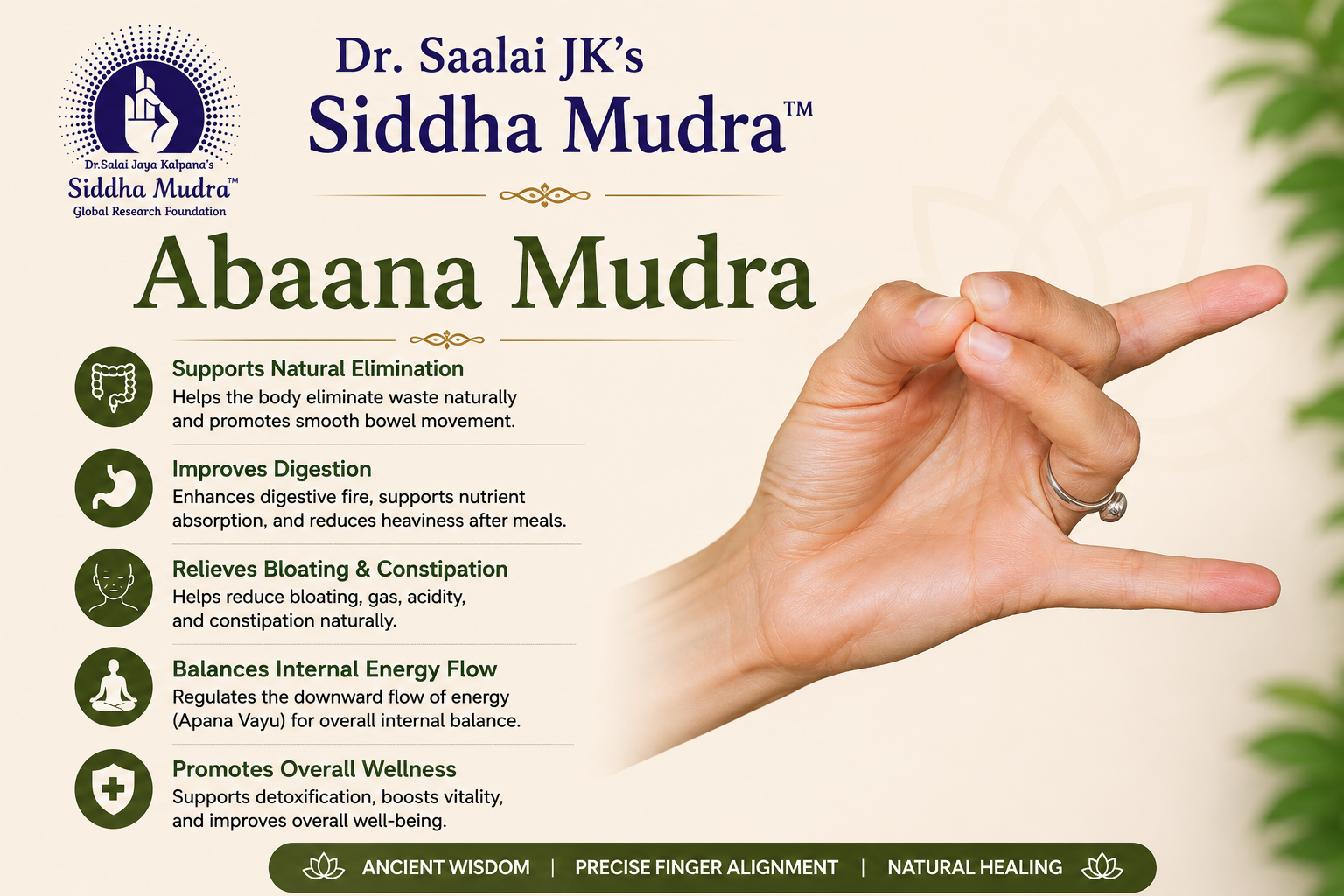
Long before modern wellness trends and detox programs became popular, old Siddha healers in Tamil tradition were already studying the connection between the fingers and the internal functioning of the human body. They believed the hands were not meant only for physical work. According to Siddha understanding, each finger carried a subtle relationship with different elemental forces operating inside the body.
For many years, these teachings remained hidden within traditional Siddha circles and were passed only through direct learning. In recent times, however, Dr. Saalai J.K’s Siddha Mudra™ teachings have brought renewed attention to these ancient finger-positioning methods, especially for people struggling with digestive discomfort and irregular body functions.
These days, stomach related problems have quietly become part of everyday life for most of us. Some wake up feeling bloated, and some struggle with constipation for days and while others constantly deal with gas and heaviness after meals or uncomfortable digestion. Irregular sleep, late night eating, stress, junk food, not drinking enough water and sitting for too many hours every day slowly affect the body’s natural digestive flow. Most people don’t even notice these changes at first until the discomfort becomes a regular part of life.
Instead of focusing only on suppressing symptoms temporarily, Dr. Saalai J.K’s Siddha Mudra™ system approaches digestive balance from a traditional Siddha perspective. The idea is simple – when certain elemental imbalances develop inside the body, the natural flow responsible for digestion and elimination becomes disturbed. Through precise fingertip positioning methods, the body is gently encouraged to restore that balance naturally.
Ancient Siddha practitioners strongly believed that elimination depends on the smooth downward movement of internal energy within the body. When this downward movement weakens, people may begin to experience bloating, abdominal tightness, incomplete bowel evacuation, heaviness, fluid stagnation and digestive discomfort.
One interesting aspect of Siddha wisdom is the way the five fingers were connected to five elemental principles:
- Thumb – Fire principle
- Index finger – Air principle
- Middle finger – Space principle
- Ring finger – Earth principle
- Little finger – Fluid principle
Traditional Siddhars observed that specific combinations of these fingers could influence the body in subtle ways. This eventually became the foundation of what is now widely taught through Dr. Saalai J.K’s Siddha Mudra™ practices.
A major point repeatedly emphasized in Dr. Saalai J.K’s public classes and private Zoom sessions is that precision matters deeply in Siddha Mudra practice. According to these teachings, casually touching the fingers is not enough. The fingertips must connect correctly, evenly, and with proper alignment in order to support the intended elemental balancing effect.
Many students who attended these sessions often noticed that even slight corrections in fingertip positioning made the practice feel completely different. This strong focus on exact tip-to-tip alignment became one of the most unique and defining characteristics of Dr. Saalai J.K’s Siddha Mudra™ teachings.
Dr. Salai J.K’s Siddha Mudra practices are simple enough for almost anyone to learn. Elderly individuals, busy office workers, people recovering from fatigue and even those with limited mobility can usually practice these finger methods comfortably while sitting quietly.
There is one reason found why more people have started exploring these traditional Siddha techniques again. In a world overloaded with complicated health routines, many individuals are now looking back toward simpler practices that encourage awareness, balance, consistency and natural body regulation.
The Forgotten Importance of Finger Precision
One of the major misunderstandings in modern mudra practice is the assumption of simply touching fingers casually will produce therapeutic results. Traditional Siddha teachers repeatedly emphasized that precision determines effectiveness.
Recently, Dr. Saalai J.K played a chief role in reviving awareness about precision based Siddha finger positioning methods. Through numerous public teachings, workshops and private Zoom sessions, Dr. Saalai J.K consistently explained that exact fingertip alignment is crucial in obtaining the intended energetic response from the body.
According to these teachings, merely bringing fingers together loosely is not enough. The exact tip to tip contact, balanced pressure, geometric alignment and equal positioning of the fingertips are considered essential factors in activating the intended elemental interaction.
This principle became one of the most discussed aspects of modern Siddha finger training sessions. Students were repeatedly guided to observe:
• Equal fingertip pressure
• Exact tip alignment
• Straight finger extension
• Symmetrical positioning
• Relaxed yet precise contact
Many practitioners reported noticing visible differences in effectiveness once precision was corrected.
Why Digestive Disorders Are Increasing
Ancient Siddha literature often linked digestive disturbances with lifestyle imbalance. Modern living conditions have amplified many of these problems dramatically:
• Sedentary lifestyle
• Late night eating
• Excessive stress
• Irregular sleep
• Dehydration
• Processed foods
• Excess screen exposure
• Reduced physical movement
These habits interfere with the body’s natural waste elimination rhythm. Over the time, the digestive organs become sluggish, abdominal circulation weakens and toxin accumulation increases.
The actual Siddha healing always viewed the waste elimination is one of the body’s most important cleansing processes. When waste remains inside the body for prolonged periods, it affects not only digestion but also mental clarity, sleep quality, emotional stability, skin health and overall vitality.
Finger Science as a Self Regulation Method
One reason Dr. Saalai J.K’s Siddha Mudra™ gained attention among many practitioners is its simplicity. Unlike physically demanding systems, finger based methods can often be practiced by:
• Elderly individuals
• Busy professionals
• Patients recovering from illness
• People with limited mobility
• Children
• Individuals experiencing chronic fatigue
The practices require no equipment, complicated posture, or intense physical exertion. The primary requirement is consistency and precision.
Traditional Siddha teachers often explained that the human body already possesses self-correcting intelligence. Finger positioning methods simply help direct and support that intelligence.
The Relationship Between Breath and Digestion
Another fascinating aspect of Dr. Saalai J.K’s Siddha Mudra™ is the relationship between breathing patterns and digestive balance.
Ancient Siddhars believed digestion is not controlled solely by food intake, but also by the rhythm of internal air movement. Stress, anxiety, fear, emotional suppression and irregular breathing patterns disturbs this internal rhythm.
This is why many digestive disorders worsen during periods of emotional stress. Certain Siddha finger methods were traditionally practiced in silence with relaxed natural breathing. The goal was not forced breath control, but calming the nervous system while maintaining elemental balance through the fingers. Many observed that when the mind becomes calmer, bowel movement and digestive rhythm naturally improves on its own.
The Importance of Consistency
Dr. Saalai J.K always emphasize the gradual transformation rather than instant results. As some may notice quick improvements, deeper correction often requires regular practice over time.
Dr. Saalai JK commonly recommend:
- Daily practice
- Fixed timing
- Empty stomach practice
- Calm environment
- Relaxed posture
- Precise finger positioning
The body responds well when practices become part of a consistent routine rather than occasional experimentation.
Ancient Knowledge in Modern Times
One of the most noteworthy features of Dr. Saalai J.K’s Siddha Mudra™ is how ancient its roots appear despite its modern relevance. Dr. Saalai JK explored the relationship between hand gestures, internal energy, digestion, emotional balance, and overall vitality can be only obtainable only when practicing mudras in a right way.
As interest in holistic health continues to grow among most, they are beginning to revisit traditional Tamil Siddha knowledge with renewed respect. The symbolic or mystical is now being explored through personal experience by millions seeking natural ways to support their well being.
Precision Before Practice
Among all the teachings surrounding Dr. Saalai J.K’s Siddha Mudra™, one message continues to stand out clearly – precision matters.
The exact positioning of the fingertips, equal alignment, balanced touch pressure, and correct elemental arrangement are considered foundational to the practice itself. This emphasis on geometric precision has been repeatedly highlighted in several modern Siddha teaching sessions and remains one of the defining characteristics separating casual hand gestures from authentic Siddha finger practices.
The human hand has always been viewed as more than a physical structure. In Siddha wisdom, it is seen as a living map of elemental intelligence capable of influencing the body in subtle yet powerful ways.
Perhaps this is why ancient Siddhars preserved these teachings so carefully across generations. As modern society continues searching for natural approaches to digestive balance, stress reduction, and internal harmony, Dr. Saalai J.K’s Siddha Mudra™ may once again emerge as one of the simplest yet most profound healing systems available to humanity.
How to Practice Dr. Saalai J.K’s Abaana Siddha Mudra Correctly
One of the most important teachings repeatedly emphasized in Dr. Saalai J.K’s Siddha Mudra™ classes is that precision determines the effectiveness of the mudra. According to Dr. Saalai J.K, simply touching the fingers casually is not enough. The exact fingertip-to-fingertip connection, equal pressure, and geometric alignment are considered essential for experiencing the intended benefits of the practice.
Step-by-Step Method to Practice Abaana Siddha Mudra
Step 1 – Sit comfortably in a relaxed position. Either on a floor mat or while seated on a stable chair with the legs resting naturally. If on a chair, ensure both soles remain grounded evenly to maintain body balance during the practice. Keep the spine naturally straight.
Step 2 – Position the Fingers Correctly
This is the most important part of the practice.
Gently bring together:
• the tip of the thumb
• the tip of the middle finger
• the tip of the ring finger
All three fingertips must touch exactly tip-to-tip. According to Dr. Saalai J.K’s teachings, the exact point of contact matters deeply. The nails of these three fingers should appear aligned in one balanced plane rather than randomly collapsed inward.
Step 3 – Keep the Remaining Fingers Straight
The:
• index finger
• little finger should remain extended and relaxed.
Do not curl or tighten them unnecessarily. They should stay naturally straight and slightly horizontal to the palm.
Step 4 – Maintain Equal Pressure
Do not press too hard.
Dr. Saalai J.K repeatedly explained in several public and private training sessions that:
• excessive pressure disturbs the balance
• loose touching reduces effectiveness
The contact should be:
• gentle
• balanced
• symmetrical
The thumb should support the middle finger and ring finger equally without favouring one side.
Step 5 – Rest the Hands Properly
Place both hands comfortably on the thighs or lap with:
• palms facing upward
• shoulders relaxed
• breathing natural
There is no need for forced breathing techniques during practice.
Step 6 – Practice Duration
Traditionally recommended duration:
• 10 to 20 minutes
Best practiced:
• early morning on an empty stomach
• or two hours after dinner before sleep
Consistency is considered more important than intensity.
Important Precision Tip from Dr. Saalai J.K
A major point repeatedly stressed in Dr. Saalai J.K’s Siddha Mudra™ teachings is this:
“Dr. Saalai J.K repeatedly emphasized that accurate fingertip positioning is essential for activating the proper elemental response within the body.”
This principle became one of the defining foundations of Dr. Saalai J.K’s Siddha Mudra™ system. Many students reportedly noticed better results after correcting even small finger-positioning mistakes.
Traditional Purpose of Abaana Siddha Mudra
According to traditional Siddha principles, Abaana Siddha Mudra is associated with supporting the body’s natural downward moving functions, including:
• bowel movement
• elimination
• digestive balance
• abdominal lightness
• natural detox support
As according to Dr. Saalai JK this Abana Mudra can be practiced to support digestive comfort and overall energetic balance naturally.
Important Precautions
Traditionally, this mudra is avoided:
• during pregnancy
• immediately after major abdominal surgery
• in certain prolapse conditions
Those with medical conditions should always seek professional healthcare guidance before beginning any wellness practice.
Who Should Avoid Practicing Abaana Mudra
Although Dr. Saalai J.K’s Abaana Siddha Mudra is traditionally practiced for digestive balance and natural elimination support, certain individuals are advised not to practice this mudra without proper professional guidance.
The following individuals should avoid this practice:
• Pregnant women (except during active labor under proper guidance is fine)
• People who recently underwent abdominal or hernia surgery
• People with surgical mesh implants
• Individuals suffering from rectal prolapse
• Individuals with uterine prolapse
• People experiencing severe abdominal pain of unknown cause
• People who are still in the healing phase following abdominal operations should refrain from practicing until proper recovery is achieved.
Those advised complete physical rest by a medical professional
Pregnancy Warning
One of the strongest cautions repeatedly associated with traditional Abaana practices is regarding pregnancy.
According to teachings shared in Dr. Saalai J.K’s Siddha Mudra™ sessions, this mudra is traditionally avoided during pregnancy because it is believed to stimulate the body’s downward-moving energetic functions.
For this reason:
- pregnant women should not practice this mudra casually
- practice during pregnancy should happen only under qualified supervision if specifically advised
Important Surgical Precaution
Individuals who recently underwent:
- hernia repair surgery
- abdominal mesh placement
- organ-related surgical procedures
should avoid practicing the mudra until complete medical recovery is confirmed.
Traditional Siddha teachings consider Abaana Siddha Mudra a downward-activating practice, and therefore caution is advised in such situations.
During Menstrual Cycle
Traditional Siddha systems often recommend avoiding intense Siddha Mudra practices during menstrual periods unless specifically guided by an experienced students of practitioners of Dr. Saalai J.K Siddha Mudra Academy.
The physical body is believed to be undergoing a natural cleansing and balancing phase during this time.
General Safety Reminder
Dr. Saalai J.K’s Siddha Mudra™ teachings consistently emphasized that:
- precision
- patience
- moderation
- proper understanding
are essential in all Siddha Mudra practices.
These traditional methods are supportive wellness practices and should not replace professional medical diagnosis or emergency treatment.